We recently attended a wealth conference focused on registered investment advisor (RIA) growth strategies. Across the presentations and panel discussions, several themes consistently emerged: organic growth pressure, referral optimization, operational scalability, customer relationship manager (CRM) adoption, and efficiency driven by artificial intelligence (AI). The industry is clearly shifting from relationship-based “accidental growth” toward intentional, measurable, and technology-enabled growth strategies.
New Rules for the Next Phase of RIA Growth
As traditional growth drivers give way to a more deliberate model, RIAs must be prepared to navigate new realities:
- Growth can no longer rely solely on market appreciation or chance referrals.
- Operational excellence is emerging as a competitive differentiator.
- The ability to scale efficiently and intentionally is imperative.
- CRM and AI technologies are maturing as foundational building blocks for growth.
Organic Growth Is the New Competitive Battleground
When revenues trend upward from year to year, it’s natural for RIAs to feel complacent — or even optimistic. But is it organic growth? Not always. As explained by Jason Gordo and Gary Roth of Modern Wealth, organic growth has nothing to do with market performance. Instead, it measures the rise in assets under management (AUM) flowing in from new and existing clients against outflows from withdrawals and client terminations.
According to DeVoe & Company’s 2025 RIA M&A Outlook Survey, more than half of RIAs cited organic growth as their top concern, far ahead of AI’s impact on the firm/industry (33%) or the economy/stock market (31%). Clearly, organic growth is what keeps advisors and executives up at night.
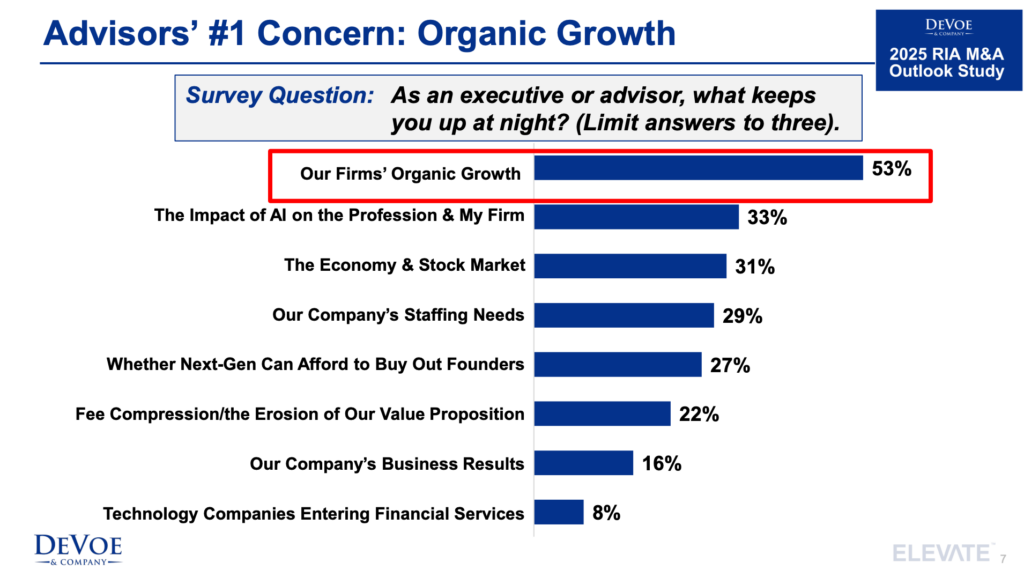
Image courtesy of DeVoe & Company Elevate Conference, 2026
Why? Because valuation is directly tied to growth. As DeVoe has stated, a 1% increase in growth leads to a 7% increase in valuation.
Referrals Still Drive Growth — But Most Firms Lack a Process
The majority of organic growth comes from referrals, either from family and friends or trusted noncompeting professionals such as lawyers and accountants. These are referred to as centers of influence, or COIs. These referrals make up more than half of a firm’s organic growth, according to both Cerulli’s U.S. Advisor Metrics 2024 report and DeVoe.
Despite the clear connection between referrals and organic growth, many firms still lack a structure for their referral strategy. Industry data shared during the conference showed that only 32% of firms have a defined process for generating referrals.
According to DeVoe’s research, 52% of new clients come from referrals — yet 88% of advisors do not actively ask for referrals. This means that nearly 46% of an RIA’s growth is essentially “unearned.” So how do firms turn these “happy accidents” into intentional growth? By creating a scalable referral playbook supported by CRM technology.
Identifying and Nurturing the COIs that Matter Most
Successful firms take a strategic approach to managing COIs and treat them with the same level of attention and intentionality as their clients. Rather than viewing COIs as occasional referral sources, high-performing RIAs cultivate these relationships as long-term growth partnerships.
This requires more than simply maintaining a contact list. Firms are documenting key business and personal details, communication preferences, relationship history, areas of specialization, and referral expectations within their CRM. They are also identifying whether a COI relationship functions primarily as a referral handoff or as a more collaborative “joint venture” partnership that involves ongoing coordination and shared client engagement.
By centralizing this information within the CRM, firms can create a more consistent and proactive approach to relationship management. Advisors and business development teams gain visibility into engagement activity, referral opportunities, follow-up timing, and relationship health to help intentionally nurture COI relationships over time. As Shell Black himself has said, tracking referrals in your CRM can tell you which COIs are unlikely to refer qualified prospects, and which ones should be on your gift list at the end of the year.
CRM Has Evolved from Database to Growth Platform
High-performing firms are increasingly leveraging CRM platforms to track client acquisition costs (CAC), referrals, life cycle metrics, and other key performance indicators (KPIs) that provide visibility into the factors driving growth — and how to prioritize them. With better data and reporting, firms can identify which client segments are the most profitable, which referral sources generate the highest-quality opportunities, and where advisors should be focusing their time.
Client segmentation is another critical component of this strategy. By organizing clients into service tiers — whether based on AUM, revenue, household complexity, growth potential, or a hybrid model — firms can align service models and engagement strategies more effectively. This helps advisors deliver a more personalized experience while ensuring resources are allocated efficiently across the business.
ShellBlack has worked with many wealth management firms to design segmentation frameworks, automate service models, and improve visibility into advisor activity and client engagement within Salesforce. These strategies help firms create more consistency across the client experience while improving operational scalability.
Automation also plays a major role in productivity. By streamlining workflows, automating administrative processes, and standardizing repetitive tasks, firms can give advisors more time to focus on client relationships and business development. According to Fidelity, advisors spend nearly 59% of their time on non-client-facing activities — which means there is a significant opportunity for efficiency gains through automation and process optimization.
In addition, CRM platforms can help firms proactively identify opportunities and risks across their client base. This includes tracking value-added services, monitoring engagement levels, identifying high-risk relationships, and using age-band segmentation to prepare for generational wealth transfers. For many firms, ensuring that beneficiaries and next-generation family members are connected with the right advisor has become an important part of their long-term retention strategy as they look to preserve AUM across generations.
Scalability remains a key concern, and firms that operationalize referrals, segmentation, automation, and client engagement through CRM technology will be better positioned to grow efficiently while delivering a stronger client experience.
AI Is Reducing Operational Drag
While still in the early stages of adoption, AI is quickly becoming an important operational advantage for high-performing RIAs. Rather than replacing advisors, AI is helping advisors become more efficient by reducing administrative tasks and creating more capacity for growth-focused activities.
The opportunity is significant. According to Kitces Research, advisors spend approximately 34% of their time on back-office client work — including meeting preparation, analysis, and follow-up — in addition to another 8% dedicated to administrative tasks. By reducing the time spent on manual processes, AI can help advisors reclaim valuable hours each week, and that time can be redirected toward higher-value client engagement, relationship development, and business growth initiatives.
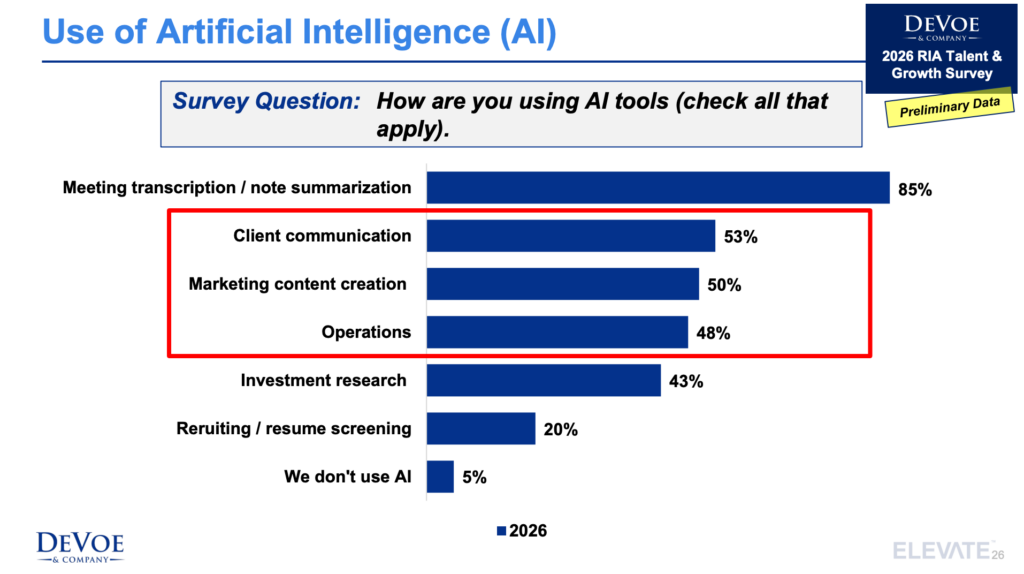
Image courtesy of DeVoe & Company Elevate Conference, 2026
Beyond operational efficiency, firms are also using AI to enhance personalization at scale. AI-powered tools can help identify client communication opportunities, generate tailored follow-up messaging, support marketing campaigns, and improve outreach for prospective clients. For firms focused on delivering a more consistent and responsive client experience, these capabilities are becoming increasingly valuable.
At the same time, adoption within the wealth management industry will likely continue at a measured pace. Regulatory oversight, compliance considerations, data governance, and privacy requirements remain critical concerns for RIAs evaluating AI solutions. As a result, firms are prioritizing AI tools that integrate securely within their existing technology ecosystem and align with compliance expectations.
Over time, AI is expected to become a foundational component of the modern advisory practice — not simply as a productivity tool, but as a strategic enabler of scalable growth, operational consistency, and enhanced client experiences.
Fueling Your Next Era of Growth
For firms focused on stepping up organic growth over the next decade, now is the time to fine-tune your:
- Intentional growth strategies
- Operational discipline
- CRM maturity
- AI-enabled efficiency
At this stage, your CRM should be helping your firm drive measurable growth — not just storing data. Contact ShellBlack today to learn how leading RIAs are leveraging CRMs like Salesforce to scale referrals, client engagement, and operational efficiency.